Christian Reiter appointed professor
Umrüstung, Aktuell |

The professorship holds the acronym ANT. “For us, the name ANT is more than just an acronym – it symbolises a structured, networked and persistent way of working, very much in the spirit of the ‘ant’,” says Christian Reiter. “It is particularly important to me to link the TUM School of Engineering and Design (ED) even more closely with the FRM II in order to strengthen research, innovation, and teaching in the field of nuclear technology in the long term.”
With a team of 35 employees, he will continue to lead the conversion of the FRM II to low-enriched uranium (LEU): “A project of national importance for the security and sustainability of German neutron research,” he says.
New study programme
This will also result in the creation of a junior research group for experimental nuclear technology, which will be particularly involved in the FRM II nuclear fuel laboratory and will research new methods for investigating and further developing materials and fuels for future reactor systems. The focus will be on advanced reactor systems, which are to be further developed into a complete digital system – a ‘digital twin’ – to combine research, training, and safety technology. A particular focus will be on the further development of modern applications of nuclear technology. In cooperation with industry partners, concepts for optimised neutron generation for various scientific, medical and technological fields of application will be advanced. In addition, a new master’s programme in ‘Nuclear Technology and Applications’ is being created to prepare students for the internationally networked applications of nuclear technology – from reactor physics and simulation to medical and materials research.
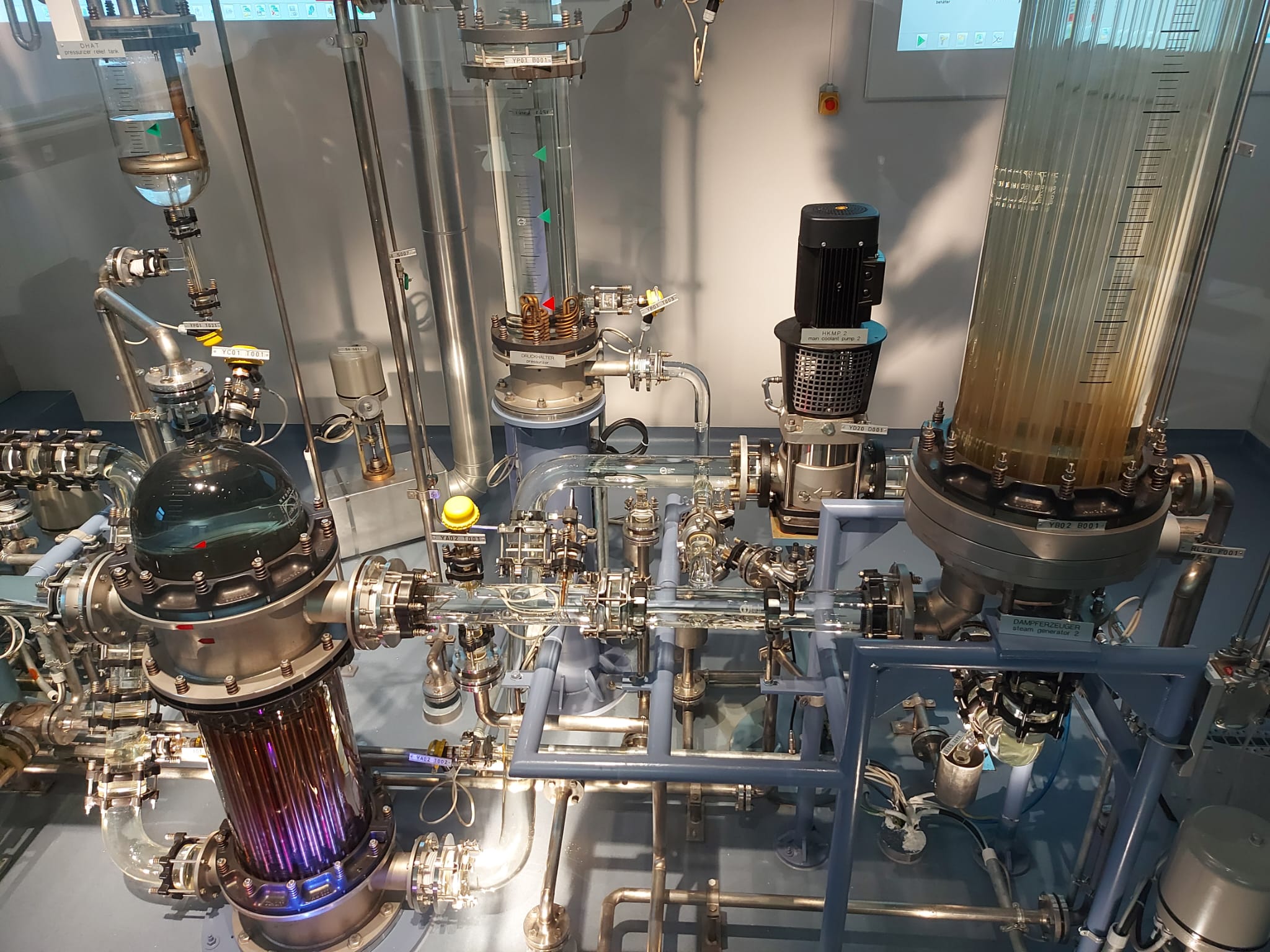
Glass model of a pressurised water reactor
The glass model of a pressurised water reactor, which TUM was able to acquire thanks to the generous support of ITM, Senator h.c. Udo Vetter and Dipl.-Phys. Oliver Buck (TUM alumnus) will also be an important element of nuclear engineering education and public relations work in the future.
“The glass model offers a unique opportunity to make the complex flow and safety principles of a nuclear power plant visible and intuitively understandable,” says Christian Reiter. “This gives us the opportunity to make modern nuclear technology even more accessible to students, researchers, and the interested public.”
During his diploma and doctoral thesis at TUM, Christian Reiter had already worked on fuel development and calculations for the FRM II fuel element. He then led reactor physics at the research neutron source and, three years later, took over as head of the overall project to convert from highly enriched to low-enriched uranium at the FRM II. Since 2022, Christian Reiter has served as the head of the TUM Centre for Nuclear Safety and Innovation and is also an adjunct professor at McMaster University in Canada.
Breakthrough in conversion to new fuel
At the end of 2022, Christian Reiter and his team achieved a breakthrough in calculating the conversion to LEU-fuel. For the first time, the researchers used complex computer simulations to identify a conversion option that works with fuel enriched to less than 20% fissile uranium-235. For this achievement, Christian Reiter was awarded the Young Scientist Prize by the Committee Research with Neutrons (KFN) in 2024. “Since then, we have been making continuous and substantial progress on the conversion,” says Christian Reiter. At the end of 2025, the application for approval of the conversion will be submitted to the regulatory authority.
The scientific director of FRM II, Prof. Dr. Christian Pfleiderer, is delighted with the appointment: “As a university, TUM operates one of the most powerful research reactors in the world, the FRM II. Together with Radiochemistry Munich, the Chair of Nuclear Engineering and the new Chair of Applied Nuclear Engineering, TUM offers a portfolio in the field of nuclear research that is unique in Germany.”